Apple Health's Weird Workout Assumptions
UPDATE: Only a few months after I wrote this, I opened Apple Health and suddenly saw a much higher number by my workout. Is it correct? No idea. How is it being generated? I haven’t yet tried to match these numbers to time, weight moved during the workout, etc. (Traditional Strength Training still just asks for calories, as described below.)
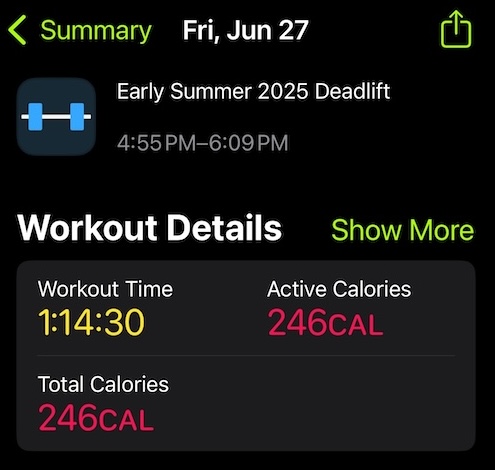
Content note: this post discusses the “calories burned” during workouts, but mostly really absurd numbers
It all started when I bought a heart monitor.
Well, back up a little bit. In Spring 2023, I started powerlifting. I’d done some weight training before, mostly dumbbells in the 12-25lb range, but powerlifting is a completely different adventure. It turns out I love it! I’ve done regular cardio for ages and I did ballet as a kid into my teens, but never had a sport give me either the pleasure or the competence I feel when powerlifting.
After some experimentation, I subscribed to the Strong app to track my sessions.
Three Systems Beat as One
Back to the heart monitor. I’ve been doing cardio on an elliptical since I was 18 and still try to do it on the weeknights I’m not lifting. Lately, I’ve been more and more aware that my mental sense of an appropriate heartrate is out of alignment with where I should be at 39. I finally bought a Garmin heart monitor at the end of the year so I could watch my heartrate on the elliptical during my cardio workouts.1
At the beginning of January, once I got my heartrate monitor, I started logging all my cardio workouts in Strong alongside my powerlifting sessions. Then I turned on the connections between my Strong app and my phone’s Apple Health.
The idea was:
- Strong app sends workout type, time spent on the workout, and weight or miles as appropriate.
- Garmin sends heartrate data.
- Apple Health then combines these into a lovely, unified dashboard.
… that was the idea, anyway.
Weird and Wild Assumptions of Apple Health
On the one hand, it works. My workouts all show up in Apple Health. I haven’t found any good way to get trends from the heart data, but it’s there.
On the other, I learned that Apple Health’s programmers have absolutely no idea to do with weight-based workouts. A workout summary in Strong could look like this:
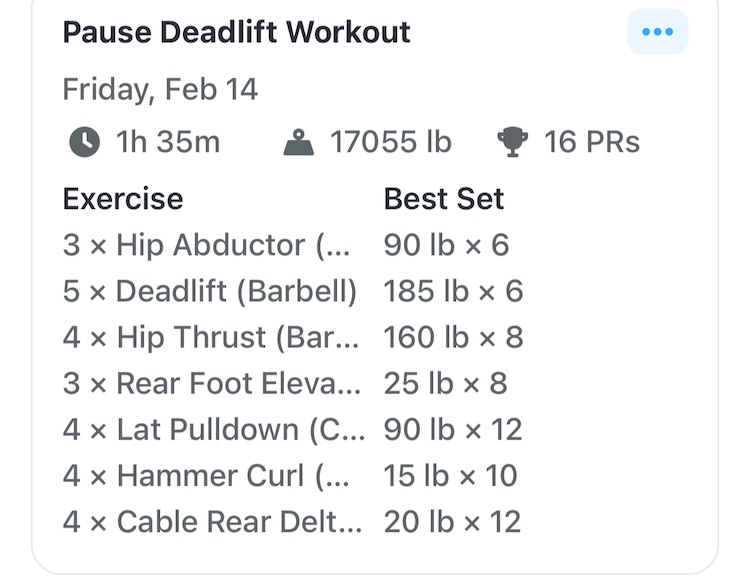
And the next time I opened Apple Health, I’d get notifications like this:
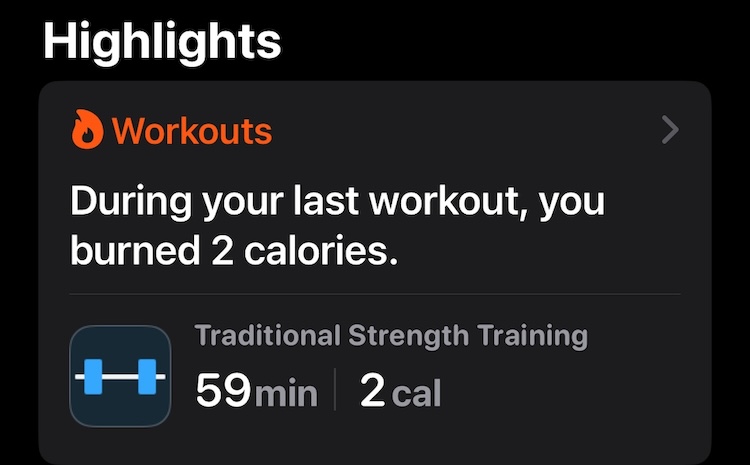
Since that’s not the same workout as the one I showed above,2 we can look at the Apple Health Active Calories for the day:
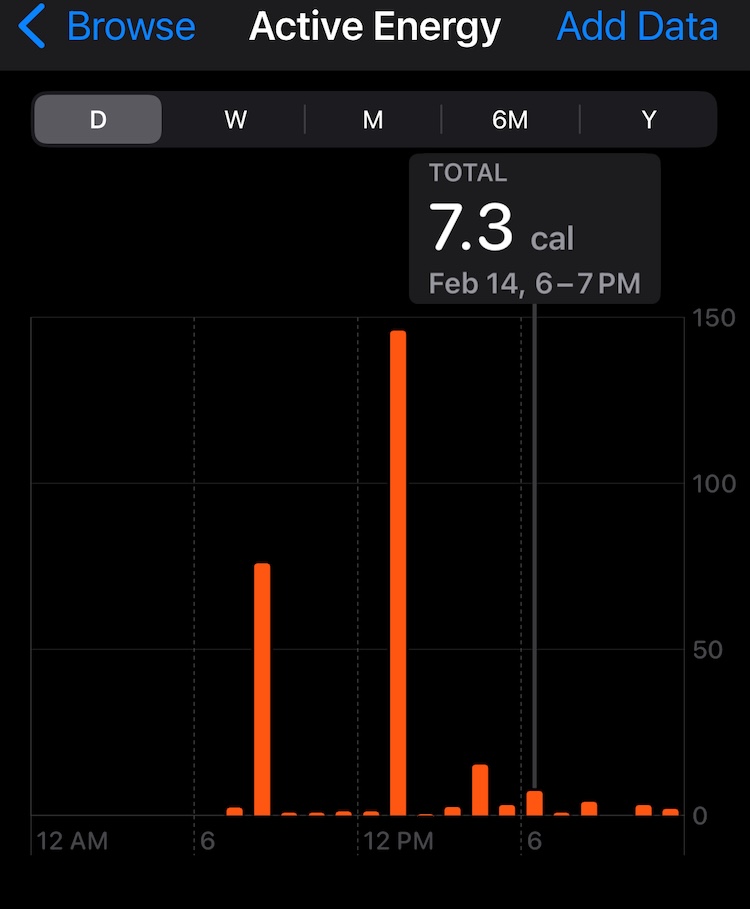
Based on my experience, 7.3 seems high for their estimates. I’d guess it still put me down for 4-5 calories from the workout and I was just walking around the gym enough to be awarded another few for being on my feet.
Lest you think that this is just Apple mis-processing all data it gets from Strong, I just logged tonight’s elliptical workout. I went for 45 minutes and, per the machine, traveled 3 miles, which I recorded in Strong. Apple Health’s assessment:
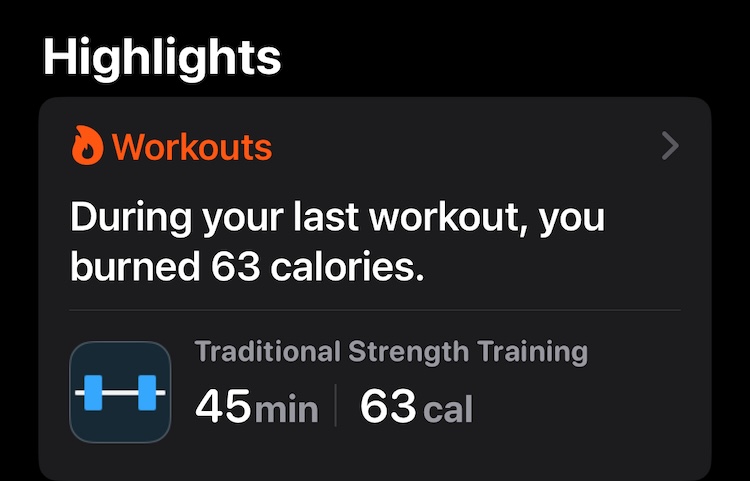
While it’s not especially generous with those calories burned, that’s a much much larger number than I get for powerlifting. It still logs as Traditional Strength Training. I also saw that Apple Heath recorded a total of 98.4 calories of Active Energy for that period, which it may be pulling from my approximate step count while on the elliptical.
Apple’s Datapoints and Interchange
One of the reasons I’ve never bothered to track my lifting workouts in Apple Health is that it feels kind of pointless.
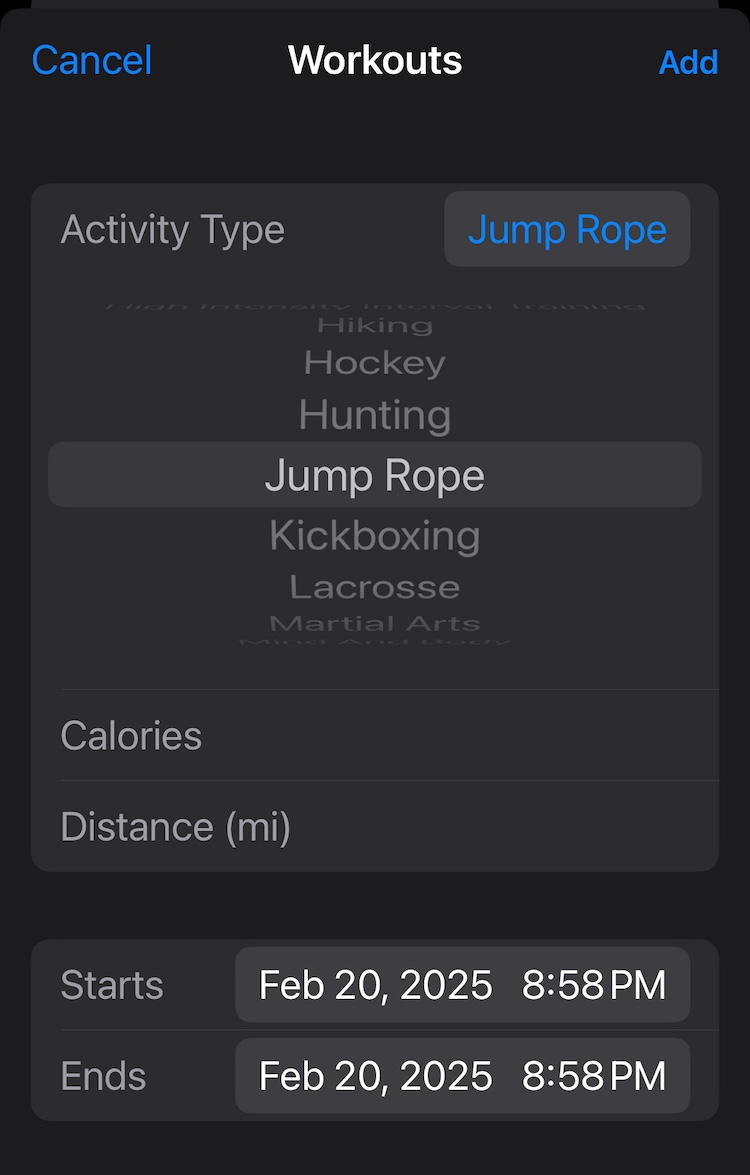
If you enter Traditional Strength Training it just asks for calories. That’s not what we do here.
Strong doesn’t calculate or have a manual place to enter calories on a workout. As I said, that’s not what we do here. So I am going to go out on a limb here even though I can’t see behind the scenes and guess that:
- Strong is sending workout timestamps and a workout type of Traditional Strength training.
- When there is a distance involved, Strong also sends that.
- Strong is NOT sending estimated calories for any kind of workout.
But then Apple Health feels the need to display something, anything in the calorie field. It’s handling this by putting in something between one calorie per quarter hour and one per half-hour.3 When it gets a distance, it throws in a few more calories. This number evidently isn’t based on anything. Even a very low number for Traditional Strength Training would be at least 100 calories/hour.4
Assessment is Hard
Part of what sparked my blog post about this fairly trivial issue was a concerned alert I got from Apple Health earlier this week:
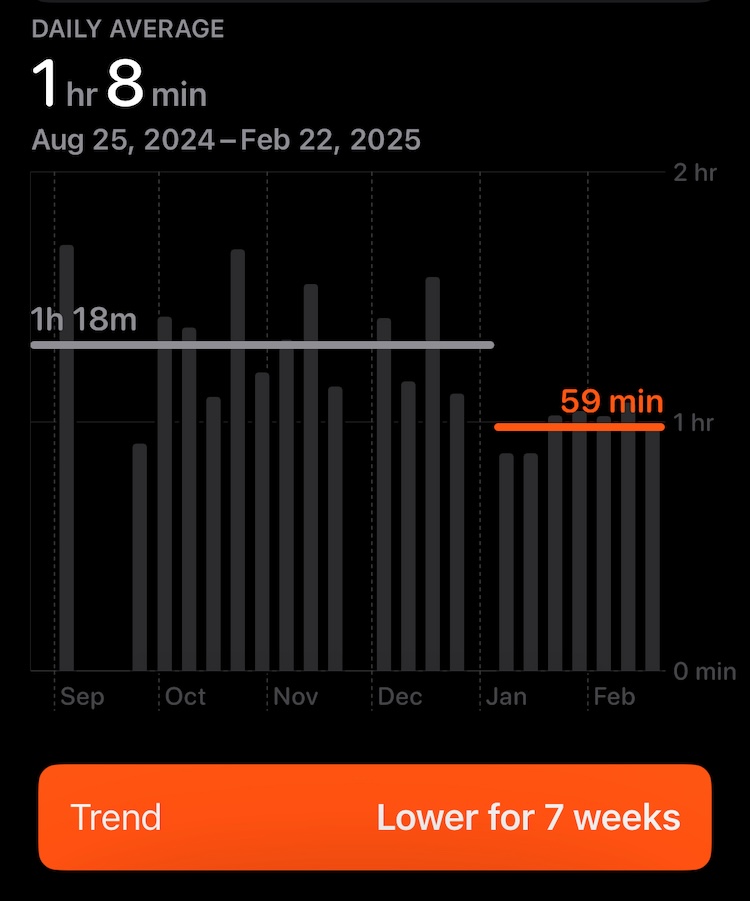
The average length of my workouts has been trending lower for 7 weeks! Oh no!
Now if you recall what I wrote earlier and have decent math literacy, you’ll see what’s happened: I started tracking my cardio.5
Suddenly, instead of only logging longer workouts, I’m throwing in a bunch of cardio sessions which range from 30-45 minutes.
Am I working out more times per week? Yes.
Am I working out more hours per week? Yes.
Would any reasonable assessment of these numbers say “there is more happening per week?” Yes.
I’m not offended as a lifter. But looking at it from my day job as a technical librarian, I can understand the choice not to program in default calories for each exercise but I cannot understand the choice to be this wrong about it instead of leaving it blank. I’m someone who sets specifications for developers as they bring data together from several systems. I’m the one has to handle questions about those decisions. When I look at this number, I feel something between the curiosity about systems that sparked these reflections and deep, deep second-hand embarrassment.6
Clearly whatever “Assessment” logic triggered this flag wasn’t set to run assessment for other changes related to time spent working out. Is length the only metric they care about (see data entry above)? Do they only care about decreases vs. increases?
When compared with the various fitness apps I tried out, I’m not really sure what Apple Health is going for here. Considering how little it cares about workout data7 it’s still desperate to show you something apparently meaningful. It seems to be generating calories from ether. It seems to have been programmed in a way that isolates random datapoints from their context.
I don’t know if I’m ready to divorce it from my Strong app just yet because I like pairing those elliptical workouts, but this marriage really isn’t working out.
-
It’s a massive PITA actually because I don’t have a smart watch and this elliptical is a decade old and has never heard of Bluetooth so I have to send it to my iPhone and watch on that screen. But I manage. Also oh god, I’ve been doing this for 21 years. ↩︎
-
Full disclosure, I’m not showing specifics of that 59 minute workout because I bailed early on a bad night. But these badges only show the most recent one so that’s all I could screenshot. During those 59 minutes of lifting I still moved 13,000+ pounds before leaving. Also that big spike of 150 calories burned at 1pm is just me going on a chill lunchtime walk! ↩︎
-
Based on my casual observation of these badges when I’m opening it up to check my estimated step count for the day or watch my heart rate. ↩︎
-
Traditional here is contrasted with Functional, the only other strength option it provides. Where are powerlifting and Olympic weightlifting? ↩︎
-
While I wasn’t previously sending any of this to Apple Health, it appears to have ingested all of my Strong data when I connected them. ↩︎
-
One of our developers had a previous career as a personal trainer and she’s a real champ about getting my “today in Apple Health’s programming decisions” updates. ↩︎
-
Not even a “total weight lifted” field? really? ↩︎